

When lists are pieced together about baseball’s hardest throwers, the usual names arise: Nolan Ryan, Aroldis Chapman, and Bob Feller, to name a few. All of these players could throw a baseball consistently over 100 miles per hour. Chapman holds the honor of throwing the fastest pitch in MLB history at 105.1 miles per hour.
But what if a prospect was touted with throwing 168 mph? That’s what was being said about the mythical Sidd Finch.
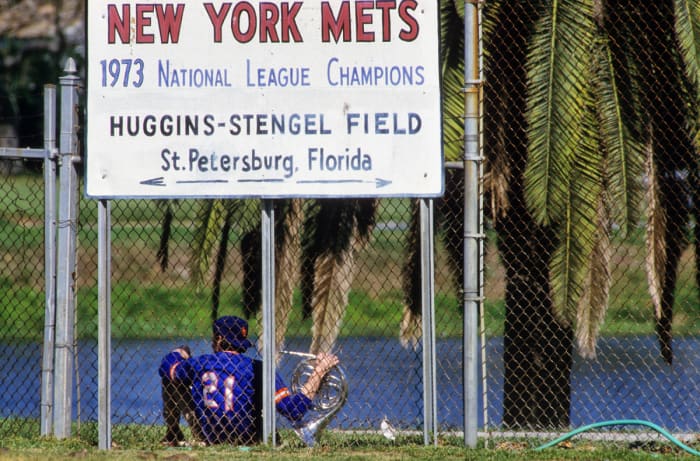
According to reports, Finch pitched with his left foot bare and his right foot in a boot. He was also a yoga master and was on the verge of becoming a professional at playing the French horn. He was baseball’s new Renaissance man.
At least, he would have been if he were real.
This too-good-to-be-true, once-in-a-lifetime talent was the figment of Sports Illustrated and George Plimpton. Despite the exaggerations perceived of Finch, many people and news stations fell for the joke on April Fools’ Day 1985.
The story of Sidd Finch began when Sports Illustrated‘s managing editor at the time, Mark Mulvoy, realized that the cover date for their April issue would land on April 1. Mulvoy, intrigued by this idea, hired legendary journalist Plimpton to author an article highlighting some of sports’ best April Fools’ pranks.
Plimpton ran into an issue with this: He couldn’t find enough examples of jokes. But, he did come up with the idea of creating his own April Fools’ Day hoax with Finch. Once he received approval from Mulvoy, Plimpton began working.
Plimpton soon crafted the character of Hayden Siddhartha “Sidd” Finch, a rookie baseball player recently signed by the New York Mets. According to Plimpton’s fable, Finch was an orphan in England adopted by an archaeologist. He was orphaned once again when his adoptive father died in a plane crash in Nepal.
On his own, Finch worked his way to Harvard University, and, upon graduation, traveled to Tibet learn yoga mastery from “the great poet-saint Lama Milaraspa.” Upon finishing his time in Tibet, Finch decided it was time to pick a career path, but was torn between baseball and professionally playing the French horn.
Throughout the process of writing the story, Plimpton was a wreck, according to novelist Jonathan Dee, who was Plimpton’s assistant at the time. “Nothing, he knew, falls quite so flat as a bad joke,” said Dee. “Such was his anxiety that, for the one and only time in my five years in his employ, he asked me to come in to work on a Saturday. I still remember my naïve astonishment at the sight of a world-famous, successful writer actually agonizing over whether something he’d written was good enough, funny enough, believable enough, or whether the whole thing would wind up making him seem like a national jackass.”
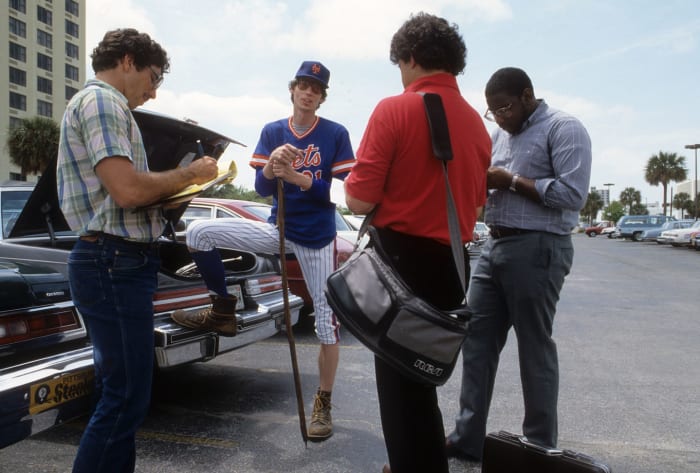
As Plimpton was preparing the article, Sports Illustrated photographer Lane Stewart began collecting photos for the publication. He recruited Joe Berton, a junior high music teacher and friend of Stewart’s, to be Finch in the photos.
The article was released in late March, and Mets fans were overjoyed at the “news” of this new, heat-throwing prospect. In a day before the internet could make fact-checking such a story possible for the average person, many fell for the hoax. Both Sports Illustrated and the Mets’ public relations department were flooded with requests for more information about Finch. Numerous newspapers and media outlets sent reporters to find Finch. Even a radio talk show host claimed to have seen Finch pitch before.
The Mets continued to play into the hoax by inviting Berton as Finch to their spring training. He was given a locker between all stars Darryl Strawberry and George Foster, and he was awarded jersey number 21. When it was reported that there would be a press conference to introduce Finch on April 2, ABC, NBC, CBS, and local newspapers from St. Petersburg, Fla. arrived to cover the press conference. When the conference came about, Berton stood at the podium in full uniform to announce Finch’s retirement.
The next week, Sports Illustrated wrote about Finch’s retirement. The week after that, they published their final article on the subject, admitting to the hoax.
The story of Sidd Finch is one that has stood the test of time within baseball. Upon the success of the hoax, Plimpton took the story of Finch and expanded it into a novel in 1987. In 2015, ESPN produced a 30 for 30 short on Finch. That same year, the Brooklyn Cyclones, the Mets’ single-A minor league team, held a Sidd Finch bobblehead night, inviting Plimpton’s son to throw out the first pitch and Berton to reprise his role as Finch to sign autographs.
Since 2019, a race horse named after Sidd Finch has competed at numerous racetracks around the country, including Belmont. He has three wins.
Do you know of an interesting sports story you’d like to see written in the blog? Go to the contact page, and let us know about the story. We’re always interested in hearing about new odd sports stories!
 Odd Sports Stories