

When football is on TV, do not get in the way of the fans. NBC learned this the hard way when they aired, and cut away from, what has now been christened “The Heidi Bowl,” also known as “The Heidi Game.”
On November 17, 1968, two American Football League (AFL) rivals, the New York Jets and Oakland Raiders, met at Oakland Coliseum for a 1 p.m. PST (4 p.m. EST) kickoff. Both teams were founding members of the AFL in 1960, and both franchises were on the rise. The previous season, the Jets, behind star quarterback Joe Namath, posted their first winning season in team history, while the Raiders went 13-1 in the regular season, won the AFL championship against the Houston Oilers, and lost Super Bowl II to the Green Bay Packers. In 1968, both teams were seen as the frontrunners for the AFL title and to represent the league in Super Bowl III.
The telecast of the game was broadcast nationally on NBC, with Curt Gowdy providing play-by-play and Al DeRogatis doing color commentary. The broadcast was set to start at 4 p.m. EST. Due to television rules at the time, and despite the sellout crowd for the game, the matchup was blacked out within 90 miles of Oakland.
This Sunday was a big broadcast day for NBC, as after the game at 7 p.m., they were debuting the television movie version of the children’s book, Heidi. This version of Heidi was highly anticipated, as the entire two-hour block for the film was sold to watch manufacturer Timex, making them the sole advertiser for the movie. As part of the agreement with Timex, Heidi had to air right at 7 p.m. and could not be delayed or joined in progress for any reason.
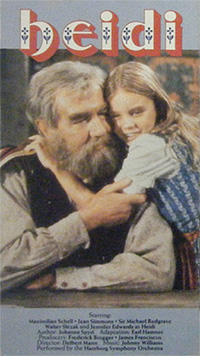
NBC was confident in the timing of their schedule, as the average professional football game at that time ran just under two-and-a-half hours, and they allotted the three hours prior to the showing of Heidi for the Jets-Raiders game.
The game was a high-scoring back-and-forth affair, with the Jets hitting a field goal to take a 32-29 lead just over a minute left to play. The Raiders would run the ensuing kickoff to the Jets’ 23-yard line. After a facemask penalty pushed them back to the 43-yard line, Oakland quarterback Daryle Lamonica found halfback Charlie Smith for a touchdown and the 36-32 lead. On the kickoff, the Jets would fumble at their 2-yard line, being recovered by the Raiders. Nine seconds after their previous score, Oakland would punch in another touchdown. They would win, 43-32.
However, only those that had watched the game at the Oakland Coliseum that day saw this incredible ending. After the Jets field goal to put them ahead with over a minute left, NBC went to commercial break. During this break, the seven o’clock hour hit, and NBC decided to switch to Heidi as planned. Because of this switch, the rest of the country did not see the Raiders’ incredible comeback.
“I waited and waited,” NBC programmer Dick Cline said about making the decision to switch from the game to the movie, “and I heard nothing. We came up to that magic hour and I thought, ‘Well, I haven’t been given any counter-order so I’ve got to do what we agreed to do.’”
Unbeknownst to Cline, NBC executives were trying to get a hold of him to tell him to stay with the game until the end. They could not reach him, as the phone lines were busy with thousands of callers: Half of them were pleading to keep the game on, and the other half were demanding the movie air on time.
Football fans across the country were furious with the switch. To add to their anger, NBC decided to print the result of the game at the bottom of the screen during the airing of Heidi, breaking the news of Oakland’s last-minute comeback. So many frustrated football fans called into NBC that night, their switchboard became overwhelmed and shut down.
The aftermath of “The Heidi Game” led to changes still seen in NFL broadcasts today. Shortly after this incident, the National Football League (NFL) inserted a clause in their network contracts that games must be seen to completion in the competing teams’ home markets. In addition, networks installed what affectionately became known as the “Heidi Phone” in their control rooms. These are direct lines between control rooms and executives to ensure no miscommunication like this were to happen again.
As for the Raiders and Jets, the two teams would meet again in the AFL championship game, with the Jets prevailing this time, 27-23. New York would go on to Super Bowl III, beating the heavily favored Baltimore Colts, 16-7.
“The Heidi Game” lives on in both sports and pop culture lore. In 2004, the game was featured in the video game ESPN NFL 2K5. In the game, the player can play as the Raiders from right after the Jets’ field goal with 1:05 left in the game to recreate Oakland’s comeback.
Do you know of an interesting sports story you’d like to see written in the blog? Go to the contact page, and let us know about the story. We’re always interested in hearing about new odd sports stories!
 Odd Sports Stories